


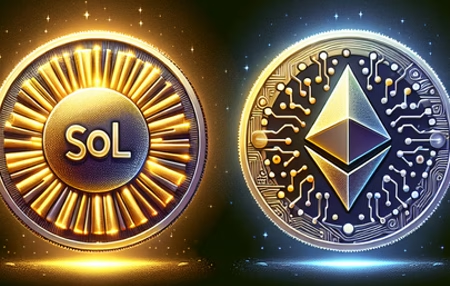
Understanding Solana: Key Insights and Mechanisms [SOL]
If you’re looking to deepen your knowledge about cryptocurrency, you’ve likely heard about Solana. It aims to construct a remarkably fast network, gaining significant attention amidst the recent surge in NFTs and projects like Stepn that allow users to earn money by walking. The popularity of Solana has accelerated in recent years, and in this article, we will comprehensively discuss its fundamental concepts. We’ll explore the motivations behind its creation, examine its various features, compare it to its main competitor, Ethereum, and address concerns regarding its security. So, stay with us till the end!
Solana prioritizes scalability and facilitates the development and construction of decentralized applications (dApps). In simpler terms, it was designed to provide a highly efficient network for the seamless trading of NFTs and cryptocurrencies, ensuring that users can navigate the system easily.
Established in 2017, Solana is operated by the Solana Foundation, which is based in Geneva, Switzerland, and is an open-source project. The token used for transactions on Solana’s blockchain is similarly named SOL. Notably, Solana boasts significantly higher processing capabilities when compared to Ethereum, allowing for a far greater number of transactions at much lower fees.
Before delving deeper into how Solana operates, it’s essential to understand why it was developed. Solana was founded by Anatoly Yakovenko, a software engineer and former Qualcomm employee who held expertise in communications technology and semiconductor design. Yakovenko realized that having a reliable shared clock would simplify synchronization, thus enhancing the speed of the network. Convinced that a high-capacity, low-cost blockchain platform was feasible, he decided to create Solana to address the long-standing scalability issues faced by blockchain technology.
To accommodate more users, it became clear that blockchain networks needed to dramatically increase their processing speed; otherwise, issues such as soaring transaction costs and system downtimes would persist. While Bitcoin and Ethereum can handle only about 15 to 20 transactions per second, Solana can reportedly process up to 50,000 transactions in the same timeframe. This remarkable capacity might seem unbelievable, but Solana’s technology indeed allows for it.
Unique Mechanisms Behind Solana’s Success
So, how is this possible? The answer lies in Solana’s innovative concept known as Proof of History (PoH). If you’re familiar with Proof of Work (PoW) or Proof of Stake (PoS), then you’ve encountered some of the traditional consensus mechanisms used in blockchain technologies. In simple terms, these methods involve recording transactions to verify and approve them, acting as crucial consensus mechanisms for managing activities on the blockchain.
Proof of History, however, improves upon previous systems by recording timestamps of past transactions on the blockchain, significantly speeding up the verification process. Yakovenko pointed out that the absence of a common clock in blockchain technology led to inefficiencies in achieving consensus and increased operational complexity.
To illustrate, in conventional transaction verification, computers must communicate repeatedly with the blockchain to determine the current time and sequence, leading to inefficiencies. However, with Proof of History, transactions are timestamped according to a centralized network clock, establishing an efficient way to approve transactions sequentially. This method allows Solana to effectively organize multiple incoming transactions without confusion, enabling it to handle a vast volume of transactions rapidly.
Comparative Insights with Ethereum
As Solana gains popularity, it often finds itself compared to Ethereum, especially as both utilize smart contracts for decentralized applications, NFTs, and other infrastructure. A critical point of comparison lies in transaction speed and costs. Solana can manage around 50,000 transactions per second, with an average transaction fee of just $0.00025, translating to less than a yen. In contrast, Ethereum can handle approximately 15 transactions per second, with fees averaging around $15, and potentially soaring during peak network congestion.
Another major difference is Solana’s reliance on Proof of Stake and Proof of History, in contrast to Ethereum’s initial use of Proof of Work. While PoW has been recognized for its reliability in transaction verification, it consumes a significant amount of electricity, seen as a major drawback. However, Ethereum plans to fully transition to a Proof of Stake model with the Ethereum 2.0 upgrade in 2022, expected to enhance transaction processing capabilities dramatically.
Despite Solana’s advantages, it faced challenges; in February 2021, the network experienced three system outages, one lasting at least 17 hours, attributed to an overload of transactions that overwhelmed the system’s memory capacity. During the same period, Ethereum also faced a similar attack but successfully mitigated the impact.
Centralization vs. Decentralization
Additionally, Solana is perceived as having a more centralized network. The number of validators (or nodes confirming transactions) is significantly lower than Ethereum—as of now, Solana has roughly 1,500 validators compared to Ethereum’s 2,000 to 4,000. This reduced number of validators can enhance speed but might compromise decentralization and security, making Ethereum potentially a more secure choice in terms of system integrity.
Ultimately, the better option depends on the user’s individual needs—whether they prioritize speed or value security and decentralization.
Conclusion
In summary, we hope this overview has provided you with a clearer understanding of Solana. Beyond serving as a cryptocurrency, its applications range from NFTs to DeFi (decentralized finance), and with its exceptional processing capabilities, Solana is poised to play a significant role in future projects. The question remains: Can Solana truly rival Ethereum in the long run? Time will tell.