



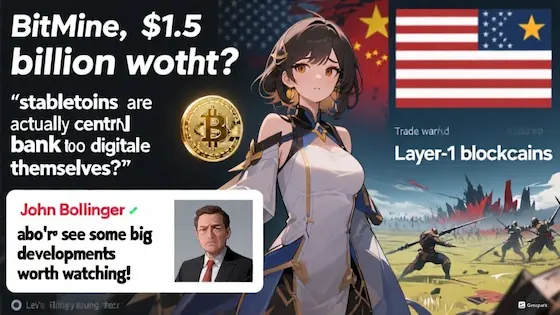
BitMine accumulates $1.5 billion worth of Ethereum, moving forward despite Lee’s concerns about a financial bubble!
Are stablecoins actually “central bank digital currencies themselves”?
US-China tensions are flaring up again, potentially impacting the trade war and Bitcoin’s slump.
John Bollinger warns, “We’re about to see some big developments worth watching!”
Layer-1 blockchains are the new battlefield, but the playing field isn’t level.
Let’s analyze the news about the global economy and cryptocurrencies and consider economic trends together!
Sunday, October 19th: We’ll be discussing today’s cryptocurrency news and on-chain market conditions.
This program brings you the latest news to help you build your wealth. Let’s start by looking at 24-hour data headlines from the cryptocurrency market.
■ As BitMine Accumulates $1.5 Billion in Ethereum, Lee Expresses Concerns about a Financial Bubble
“BitMine Continues to Buy Ethereum at an Astonishing Pace Even After the Crash.”
Even in 2024, mining company BitMine continues to aggressively purchase Ethereum (ETH), with its holdings already reaching $1.5 billion. This is a noteworthy move for the market. This move is especially significant given that Litecoin founder Charlie Lee has expressed concerns about a “financial bubble.”
While Ethereum’s price has undergone significant corrections over the past few months, BitMine appears to be aiming to preserve its value and strengthen its network for the long term. Previously, large miners and investors have engaged in large purchases after market crashes, contributing to market recoveries. This latest move is similarly being viewed by market participants as a signal to “buy at the bottom.”
This move is being analyzed within the industry from two perspectives: a restoration of confidence in the overall market and strategic positioning by mining companies. Investor sentiment remains strong, with high hopes for Ethereum despite the unstable geopolitical situation and regulatory risks.
■ Stablecoins are essentially “central bank-issued digital currencies.”
“A VC asserted that stablecoins are the ‘central business digital currency’ of modern finance.”
An interesting perspective has emerged from the venture capital community. They view stablecoins as “not simply cryptoassets, but rather an extension of digital currencies issued by central banks and financial institutions.” This means that major stablecoins, such as USDT and USDC, are essentially linked to fiat currencies and play a central role in the financial system.
This perspective is particularly important when understanding the relationship between regulators and financial institutions, and is closely intertwined with the development of “central bank digital currencies (CBDCs).” While market participants believe that stablecoins have the potential to become the foundation of the modern financial ecosystem, others are cautious, stating that the impact of stricter regulations is inevitable.
■ Reigniting US-China Tensions Combines Trade War and Bitcoin Market Slump
“The escalating tensions between the United States and China are also pouring cold water on the cryptocurrency market.”
Political and economic tensions between the United States and China, two of the world’s largest economies, are once again on the rise. This impact is spreading to the cryptocurrency market, putting negative pressure on Bitcoin prices in particular. In the past, when US-China relations have deteriorated, risk assets in general have tended to sell off, and this time is no different.
Market participants point out that “increased uncertainty due to geopolitical risks is dampening investor sentiment and driving a preference for safe-haven assets.” Furthermore, with China’s tightening regulations and the battle for technological dominance also contributing to this backdrop, this pattern may continue for some time to come.
■ John Bollinger Warns, “Watch for Significant Price Movements in the Near Future”
“Technical analyst John Bollinger predicts a period of market volatility.”
Renowned technical analyst John Bollinger recently commented that “a significant market movement is likely to occur in the near future.” This statement, based on his own Bollinger Bands indicator, has elicited a mixture of caution and anticipation from market participants.
His predictions have often marked important trend reversals in the past, and they are being closely monitored along with market sentiment and liquidity conditions. In particular, the transition from a contraction to a rapid expansion in volatility often sees increased activity from large investors and algorithmic trading, significantly impacting the overall market.
■ Layer 1 Blockchain Competition: A New Battlefield, But the Playing Field Isn’t Level
“Competition between L1 Platforms is Intensifying, but Behind the Scenes, Unequal Conditions Exist.”
Currently, multiple Layer 1 (L1) blockchain platforms, including Ethereum and Solana, are competing fiercely to innovate and attract users. However, this battlefield is not necessarily level. Some platforms enjoy favorable conditions, such as funding and partnerships, creating a tough environment for new entrants.
Industry analysts point out that “not only technical ability but also the ability to build an entire ecosystem and partnership strategies will determine success or failure.” Users also express doubts about whether free competition is truly possible, despite the increasing number of options.
■ Psychological and Economic Impact Analysis of Today’s News
Three key points emerge from this series of news.
First, major mining company BitMine’s massive purchase of Ethereum signals a return of confidence in the market and a bullish stance on future value. Meanwhile, concerns about a financial bubble remain lingering, and market sentiment remains volatile.
Second, the discussion surrounding stablecoins has raised concerns that they are becoming more deeply integrated into the modern financial system than simply being an alternative currency. Regulatory developments could potentially change the market structure itself. This is an issue that deserves more attention than ever before.
Third, there is the growing geopolitical risk caused by the intensifying US-China conflict and its impact on the cryptocurrency market. Increasing uncertainty will lead to a tendency to prioritize safety and short-term trading, increasing the risk of significant price fluctuations. Additionally, on the technology front, we are entering a new phase of Layer 1 competition, which will require each market participant to adjust their strategy.
That concludes today’s news highlights. This channel provides in-depth, specialized features focusing on valuable news in the cryptocurrency world. If you find this channel valuable, please share, follow, and turn on notifications.
See you tomorrow.