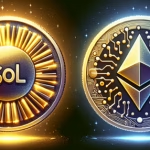











Solana’s Remarkable Rise Compared to Ethereum
Can Solana surpass Ethereum? Once a seemingly absurd question, this notion is becoming less far-fetched given Solana’s recent advancements. This article examines Solana’s technology and journey, highlighting its potential superiority over Ethereum, and shines a spotlight on this ambitious project vying for the top position among layer-1 networks equipped with smart contract functionality.
The genesis of Solana traces back to 2017 with the publication of its white paper by Anatoly Yakovenko, introducing a proof-of-stake layer-1 network. Its design aims to provide developers an environment where they can focus on developing decentralized applications without worrying about network performance—a radical concept at the time. By the time Solana’s mainnet launched in 2020, Ethereum had already cemented its dominance in the market, leading many blockchains to adapt to Ethereum’s development environment and shift towards EVM compatibility.
In contrast, Solana adopted a fundamentally different design, leveraging the Rust programming language instead of relying on EVM compatibility, and aimed to build an independent economic environment. A cornerstone of Solana’s architecture is the innovative Proof of History (PoH) mechanism, designed to solve a persistent challenge in blockchain networks: the reliance on timekeeping.
For example, Ethereum generates a new block approximately every 12 seconds, during which time each transaction waits in a mempool for inclusion in the next block. Each transaction receives a timestamp upon inclusion, revealing the approval time. However, this model presents a bottleneck because validators must communicate with one another to maintain consensus, impacting efficiency.
Solana’s Proof of History addresses the timekeeping issue by linking past hashes to create a continuous chain. Utilizing a cryptographic hash function (SHA-256), PoH acts as a timekeeper, ensuring that hashes are generated at predictable intervals. This streamlined approach eliminates the need for validators to repeatedly reach consensus, thereby expediting transaction execution and optimizing throughput.
In addition to PoH, Solana employs various technologies such as the T-BFT consensus mechanism for rapid agreement formation, parallel execution capabilities for smart contracts through C-level, and Gulf Stream, which pre-assigns transactions to upcoming validators to reduce block production times.
Solana’s native token, SOL, reached a peak of over $250 during the bullish market of November 2021. However, the cryptocurrency market faced a significant downturn at the end of that year, leading Solana into a challenging 2022 marked by network instability and the fallout from the collapse of the FTX exchange, which had heavily invested in Solana.
Despite these challenges, Solana began to rebound in the latter half of 2023, aided by network upgrades focused on efficiency and security. Features such as Quick Network, which relieves congestion by prioritizing transaction fees, and State Compression technologies, which drastically reduce the costs of on-chain data storage and NFT minting, were introduced. Additionally, the onboarding of new validator clients promises to enhance network performance and decentralization—a crucial aspect, as most networks rely on a single client, risking systemic failure in the event of a bug.
The introduction of the ‘Solana’ compiler allows Ethereum developers to deploy applications on the Solana network seamlessly, further strengthening its technical landscape. Beyond the technological innovations, the revitalization of its ecosystem has been crucial. In 2023, decentralized finance (DeFi) activities rebounded, spurred by airdrops around projects like Jupiter and Kano, leading to significant increases in total value locked (TVL).
Solana is also becoming a hub for decentralized applications, with major projects such as Render and Helium taking advantage of its capabilities. It is crucial to observe its activities, especially in the burgeoning gaming sector, anticipated to be one of the largest markets.
“Never fight Ethereum; you will always lose,” stated renowned crypto investor Jill Carlson, reflecting a common sentiment as many projects have struggled to disrupt Ethereum’s dominance in smart contract ecosystems. However, Solana’s momentum has positioned it as a formidable competitor to Ethereum.
A recurring challenge for Ethereum is fragmentation; for years, it has battled scalability issues and is now focusing on layer-2 solutions such as rollups. This has led to economic isolation of certain network segments, resulting in complications with overall operability and liquidity.
Meanwhile, Solana’s unified economic framework eliminates such challenges. The unparalleled user experience on Solana is reinforcing its appeal, as evidenced by Phantom Wallet outpacing MetaMask in app rankings and surpassing 7 million monthly users. Partnerships with established firms and the introduction of user-friendly features such as Blink further enhance its accessibility and attractiveness to prospective users.
Pantera Capital has recognized Solana’s design superiority and potential as the go-to choice for new Web3 users, intensifying its momentum. Nevertheless, the path to sustainably eclipsing Ethereum remains steep. Though Solana has shown recent gains in specific metrics such as transaction volume and user activity, Ethereum retains its commanding position in terms of TVL.
Upcoming upgrades, including EIP-444, promising reduced transaction costs in layer-2 solutions and potential long-term benefits from ETF approvals, indicate that the dynamics of the crypto market are fluid and complex. While Solana has made substantial strides, continuing on this upward trajectory poses significant challenges.
Ultimately, the ongoing debate surrounding Solana’s potential to outpace Ethereum signifies its growth and relevance in the blockchain realm. Keep an eye on the developments in this rapidly evolving sector.